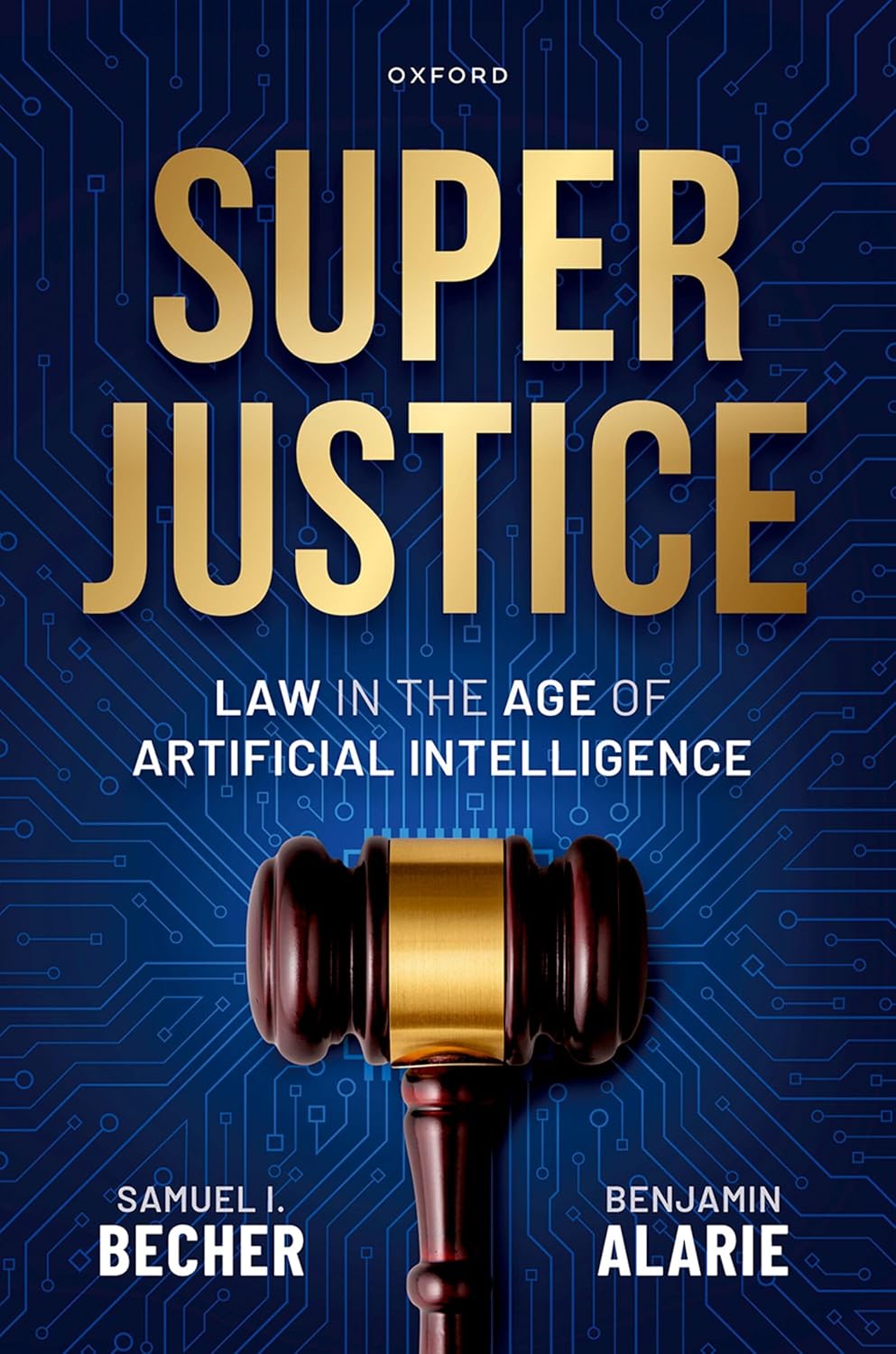
Available Now · Print, Ebook & Audio
Superjustice
Law in the Age of Artificial Intelligence
AI will transform law.
It will not automatically produce justice.
Superjustice is about how we can build law for human flourishing.
For judges, policymakers, legal scholars, law firm leaders, educators, technologists, and anyone thinking seriously about the future of justice.
Or choose your format and seller
All formats and sellers →All three editions are available now: hardcover, ebook, and audio. The complete online edition is also live at Oxford Academic for institutional readers.
About the Book
Justice delayed is justice denied. Courts are backlogged, legal help is out of reach for billions, and rigid rules struggle to keep pace with modern life. Superjustice argues for redesigning that system rather than digitizing it: law as a dynamic, responsive framework built for human flourishing, in which
- Justice becomes a universally accessible service, not a luxury for the few
- Legal gridlock gives way to responsive, data-driven solutions
- Communities gain real power through hybrid decentralized governance models
- Personalized law adapts to individual circumstances while maintaining fairness
- Human wisdom and AI capabilities combine to deliver outcomes impossible for either alone
Neither utopian fantasy nor dystopian warning. The book carries the argument through to implementation: what has to change in legal education, in professional roles, and in institutional structure to make justice abundant rather than scarce.
A follow-up collection, Beyond Superjustice, is in preparation: new papers responding to each chapter of the book and carrying its analysis forward, with a workshop in Hong Kong and a symposium in Toronto in 2027.
Read the full argument, contents, and hard parts →Latest and Next
In the press10
- Interview Schwartz Reisman Institute From legal scarcity to legal abundance: Benjamin Alarie on Superjustice
- Podcast Future Ready Lawyer Superjustice: Ben Alarie on AI, Abundant Legal Help and the Future of Lawyers
- Podcast Explain to Shane Data-Driven Decisions in the Courtroom
Upcoming events18
- Talk University of Melbourne Superjustice: Law in the Age of Artificial Intelligence
- Seminar London School of Economics Book launch
- Seminar University of Cambridge Book launch
Most recent: Creative Destruction Lab, University of Toronto, 22 September 2026, a reading group on the book and Orwell’s 1984. First held: Korea University, 16 September 2026, presented by Samuel I. Becher.
Full schedule through June 2027 →Read the Introduction Free
The complete Introduction is an open-access download on SSRN. It maps the whole argument in a few minutes of reading, so you can judge whether the book holds up before spending anything on it.